The dream of going to America as escape and hope
A Pale View of HillsThe dream of going to America as escape and hope is a promise of a life elsewhere, but not a secure destination. In Sachiko’s account, America offers distance from the rooms and constraints of her present life, a chance to build a respectable future with Frank, and the prospect of a different future for Mariko. The plan repeatedly falters, and Sachiko eventually acknowledges that she may never reach America. Even so, the possibility of departure sustains her decision to leave Nagasaki: first for Kobe, and then, as she hopes, across the ocean.
The Promise of a New Life
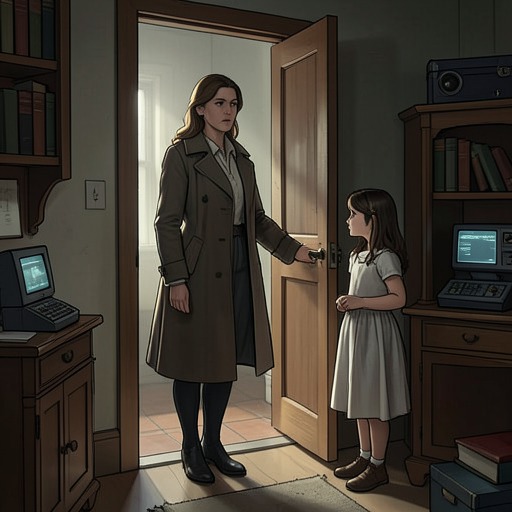
The dream first takes shape as news Etsuko does not expect. When Etsuko asks whether Mariko might be with friends, Sachiko laughs away her alarm and announces that everything has been settled: she and Mariko will leave for America within days. The abrupt shift from concern about the child to an emigration plan makes the news sound both momentous and rehearsed. Sachiko is pleased by Etsuko’s astonishment, presenting departure as a decisive break rather than a remote possibility.
For Sachiko, America is also bound to Frank’s promises. She insists that his journey to Nagasaki from Tokyo to find her at her uncle’s house proves that he means to take her there and lead a steady, respectable life. When Frank disappears, she initially treats his absence as a delay, not a repudiation: he has not gone far, she reasons, and will return because he wants America as much as she does. Her confidence rests less on what he is doing now than on the meaning she assigns to his earlier journey and his stated intentions.
The Repeated Failure Behind the Hope
That confidence has a painful history. Sachiko recalls that, in Tokyo, Frank disappeared once before and spent all their money drinking in three days. She had earned much of it herself, working as a hotel maid and scrubbing floors on her knees. After weeks of work, they had nearly saved enough for passage to America; Frank’s drinking consumed the money before they could leave. In Nagasaki, she again finds him at a bar with a woman she describes as a saloon girl. The parallel between the two episodes makes the new plan look less like steady progress than a return to a familiar crisis.
Sachiko nevertheless turns the record of Frank’s unreliability into a reason not to abandon the future she has imagined. She argues that he came all the way from Tokyo because he wanted to find her, and that his disappearance is only a slight delay. Her reassurances sit uneasily beside her account of the lost savings: the past gives Etsuko grounds for doubt, while Sachiko recasts it as hardship that has not yet extinguished the plan. The dream survives not because its practical foundations are secure, but because Sachiko continues to interpret them in its favor.
Kobe as the Intermediate Destination
The plan changes from an imminent journey to America into a staged departure. While packing, Sachiko tells Etsuko that she and Mariko are leaving Nagasaki for Kobe. Frank, she says, has friends at an American base there and has been entrusted with a job on a cargo ship. He will go to America first, find work, and send money so that Sachiko and Mariko can follow. Sachiko also claims that he has found them somewhere to stay in Kobe and arranged passage at almost half the usual cost. The route depends on Frank leaving Japan without them and on Sachiko waiting for him, a compromise she describes as the most sensible solution.
The material circumstances of departure complicate its promise. Sachiko is still packing when she explains the plan; she says she will leave some possessions behind and tells Etsuko that a loan will be repaid through the post. Mariko watches her mother while holding a kitten that struggles to join the others. Nearby, the vegetable box Mariko won at a fair has become a house for the kittens. These immediate domestic details place the hoped-for transatlantic future beside the things and responsibilities that have to be managed in Nagasaki. Sachiko’s plan does not remove the work of caring for Mariko or settle the family’s uncertain arrangements; it carries those obligations toward a new, still provisional address.
Leaving Nagasaki Even Without Certainty
In a later conversation, Sachiko admits that she realizes they may never see America and understands that life there would be difficult. Her candor changes the meaning of her earlier assurances: she is not simply unaware of the risks. She nevertheless asks what she has to lose by going to Kobe. Her uncle’s house, as she describes it, offers only empty rooms and the prospect of growing old there. Against that future, even an uncertain move has value. Kobe matters both as a practical staging point in Frank’s plan and as an escape from the life Sachiko cannot bear to continue at her uncle’s house.
Etsuko’s questions about Mariko expose the emotional price and moral pressure of that decision. Sachiko has previously insisted that her daughter comes first and that Frank is afraid of the responsibility children mean. Now, when Etsuko asks what will happen to Mariko, Sachiko asks whether Etsuko believes her to be a good mother. The exchange does not resolve the contradiction between maternal responsibility and the plan to leave Nagasaki in uncertain circumstances. Instead, it shows how Sachiko’s hope for America is entangled with her fear that she has already failed Mariko, and how departure can appear to her as both a promise for her daughter and a way out of an intolerable present.
Migration and the Retrospective View
The dream gains a quieter resonance in Etsuko’s later recollection of arriving in England. Looking back at the orchard, she remembers that the trees were not there when she first came: fields then stretched around the house, which could be seen from where she stood. She had thought the landscape looked like the England she had imagined and had been pleased by the resemblance. The memory links migration to a powerful act of imagining a destination before it becomes ordinary, while the changed orchard registers the passage of time after arrival. It does not establish what happened to Sachiko’s plan or equate her proposed journey with Etsuko’s life in England. Rather, it sets the hope of an imagined elsewhere beside the later, altered landscape of a place actually made home. For Sachiko, America remains suspended between a concrete route through Kobe and a future she knows may never come; its promise is already consequential because it gives her a reason to leave.